

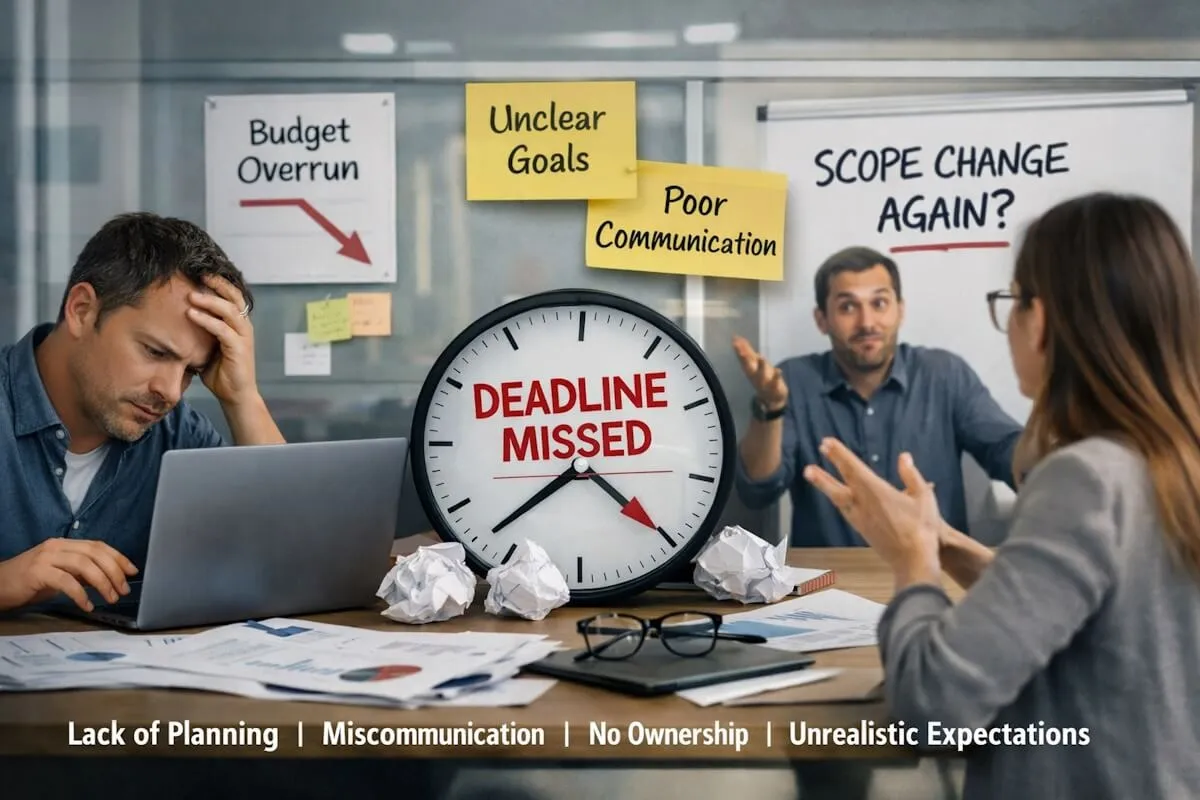
You’ve probably seen it before. A project starts with excitement. There’s a plan, a team, and a deadline that feels doable. Weeks pass. Then months. Suddenly, things feel off. Deadlines slip. Costs rise. People get frustrated.
And the first thing many assume?
“The code must be the problem.”
But that’s rarely true.
Most IT projects don’t fail because of bad coding. They fail because of decisions made long before a single line of code is written. If you’ve ever been part of a project that slowly went off track, you already know this feeling.
So what really goes wrong?
Let’s break it down.
Poor Clarity from Day One
A project without clear direction is like driving without a map. You might move, but you won’t reach the right place.
A lot of teams jump into development too quickly. There’s pressure to “start building.” Stakeholders want to see progress. So, requirements are rushed or left vague.
Here’s what that looks like in real life:
- Features are loosely defined
- Goals keep shifting mid-project
- Teams interpret requirements differently
You end up building something that technically works but misses the actual business need.
This is where strong planning and the right IT Consulting Services come into play. When you take time to define what you’re solving and why, everything downstream becomes easier.
Still, many teams skip this step.
Why?
Because planning doesn’t feel as exciting as building.
But skipping it is where problems begin.
Communication Breakdowns
Ever played the telephone game? One message gets passed around, and by the end, it’s completely different.
That’s exactly what happens in failing IT projects.
Developers, managers, stakeholders, and sometimes external vendors all speak slightly different “languages.” Without clear communication, misunderstandings pile up fast.
You might see:
- Features built differently than expected
- Feedback loops that take too long
- Assumptions replacing real discussions
And here’s the tricky part. Everyone thinks they’re on the same page.
They’re not.
Strong communication doesn’t just happen. It needs structure. Regular check-ins. Clear documentation. Honest conversations.
When teams invest in experienced professionals through Hire IT Consultants, they often notice a shift. Communication becomes more direct. Expectations become clearer.
And suddenly, fewer things fall through the cracks.
Lack of Ownership
When everyone is responsible, no one is responsible.
This is a silent killer in many projects.
You’ll notice things like:
- Tasks getting delayed without clear reasons
- Decisions being pushed around
- Problems staying unresolved for too long
No one wants to step on toes. No one wants to take full ownership. So issues sit there, growing quietly.
Successful projects are different. They have clear accountability.
Someone owns the timeline. Someone owns the technical direction. Someone owns the final outcome.
Without that, projects drift.
And once they drift far enough, it’s hard to bring them back.
Unrealistic Expectations
Let’s be honest. Sometimes deadlines are set based on hope, not reality.
A feature that needs three months is expected in four weeks. A small team is asked to handle a massive workload. Budgets are tight, but expectations are high.
Sound familiar?
This mismatch creates constant pressure. Teams rush. Quality drops. Technical debt builds up.
And then people blame the code.
But the code didn’t create the problem. The expectations did.
Experienced teams, especially those backed by IT Consulting Services, help set realistic timelines. They push back when needed. They ask the right questions early.
It might feel uncomfortable at first.
But it saves the project later.
Constant Scope Changes
Change isn’t bad. In fact, it’s expected in most projects.
But uncontrolled change?
That’s a different story.
You start with a simple idea. Then new features get added. Then priorities shift. Then stakeholders want “just one more thing.”
Before you know it, the project looks nothing like what you started with.
This leads to:
- Confusion within the team
- Rework and wasted effort
- Delayed timelines
The issue isn’t change itself. It’s the lack of control around it.
Clear processes help. Defined scope. Change approval systems. Prioritization frameworks.
When you Hire IT Consultants, they often bring that structure with them. They help filter what’s necessary and what can wait.
That keeps the project grounded.
Weak Project Management
Not every great developer is a great project manager.
And that’s okay.
But when project management is weak, things fall apart quickly.
You might see:
- Poor tracking of progress
- Missed risks
- Lack of coordination between teams
It’s not always obvious at first. The project might seem fine on the surface. But underneath, there’s chaos.
Strong project management acts like a backbone. It keeps everything aligned.
Without it, even the best technical teams struggle.
Ignoring User Perspective
Here’s a simple question.
Who are you building this for?
You’d think the answer is obvious. But in many failing projects, the end user gets lost in the process.
Teams focus on features. On deadlines. On internal goals.
But they forget to ask:
- Does this actually solve the user’s problem?
- Is it easy to use?
- Does it deliver real value?
You can build a technically perfect product that no one wants.
That’s not success.
Bringing in external experts through IT Consulting Services can help here too. They often bring an outside perspective. They challenge assumptions.
And they keep the focus where it belongs. On the user.
Resistance to Feedback
Feedback can feel uncomfortable. No one likes hearing that something isn’t working.
So teams avoid it.
Or they delay it.
Or they ignore it.
That’s a mistake.
Early feedback helps catch issues before they grow. It gives you a chance to adjust.
Failing projects often have limited feedback loops. Or feedback that comes too late.
By then, fixing things becomes expensive and time-consuming.
Open communication, regular reviews, and a willingness to adapt can change everything.
Underestimating Complexity
Some projects look simple on the surface.
“Just build this feature.”
“Just add this integration.”
“Just tweak this system.”
But once you get into it, things get complicated.
Dependencies appear. Systems don’t behave as expected. Edge cases pop up.
If you underestimate complexity, you under-plan. And when that happens, timelines and budgets take a hit.
Teams that Hire IT Consultants often benefit from real-world experience. They’ve seen similar challenges before. They can spot hidden complexity early.
That foresight matters.
The Real Problem Isn’t Code
So here’s the truth.
Code is rarely the reason projects fail.
It’s everything around the code.
Planning. Communication. Expectations. Ownership.
If those pieces aren’t in place, even the best developers can’t save the project.
But when those pieces are strong?
Even complex projects become manageable.
Where Do You Go From Here
If you’re starting a new project, take a moment.
Ask yourself:
- Are the goals clear?
- Is communication structured?
- Are expectations realistic?
- Is there clear ownership?
If you’re already in the middle of a project that feels off track, it’s not too late.
Step back. Reassess. Fix the foundation.
Sometimes, bringing in outside support through IT Consulting Services or choosing to Hire IT Consultants can give you that reset.
A fresh perspective can uncover things you didn’t notice.
And that can make all the difference.
Because at the end of the day, successful projects aren’t just built with code.
They’re built with clarity, communication, and the right decisions from the start.