

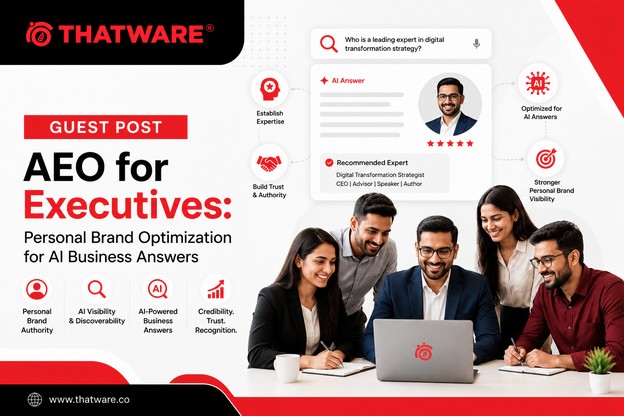
There’s a quiet shift happening in how people find business leaders online — and most executives haven’t noticed it yet. Not because they’re not paying attention, but because it doesn’t look like a shift. It looks like business as usual. Google results. LinkedIn profiles. A few press mentions here and there. But underneath all of that, something is changing in a pretty fundamental way.
AI-powered answer engines — think ChatGPT, Google’s AI Overviews, Perplexity, Bing Copilot — are increasingly becoming the first stop for people researching companies, founders, and C-suite leaders. Not the second or third. The first. And right now, most executives are either invisible in those answers or, worse, represented by whatever scattered information the AI happened to crawl.
That’s the gap that Answer Engine Optimization — or AEO — is designed to close.
Why the Old Rules Don’t Apply Anymore
For a long time, building an executive personal brand online meant getting a polished LinkedIn, landing a few speaking gigs, maybe writing a thought leadership column. It still matters, sure. But if an AI assistant is asked, “Who are the top voices in supply chain innovation?” or “Which CEOs are leading on sustainability in manufacturing?” — your LinkedIn profile isn’t what gets surfaced. It’s structured, authoritative, machine-readable content about you that does the work.
That’s a different problem than traditional SEO. And honestly, most of the advice still floating around the internet hasn’t caught up with it. There’s a lot of noise about keywords and backlinks and domain authority. But AEO is about something more nuanced — it’s about how your expertise, your story, and your brand signals get interpreted by AI systems that are trying to answer questions on behalf of real people.
It’s less like writing for an algorithm. It’s more like building a reputation that machines can verify.
What “Personal Brand Optimization” Even Means in This Context
Let’s be real — “personal brand” has become one of those phrases that sounds like something a life coach would say between mentions of their morning routine. But strip away the buzzword energy, and it’s actually just this: what do people think of you when they hear your name? What do they find when they go looking?
For executives, that question has always mattered. But in the age of AI answers, it has a new dimension. When someone asks an AI tool about the best voices in your industry, or about your company’s leadership, what does the AI say? Does your name even come up? Is the information accurate? Does it reflect the version of you that you’d actually want someone to see?
Most execs, if they’re honest, don’t know the answer to that. And that gap — between how they see themselves and how they’re represented in AI outputs — is exactly where AEO strategy for personal brands lives.
Getting that right requires more than a content refresh. It requires intentional architecture. The kind of work that a truly best AEO agency for brand authority will build around your specific positioning — not a templated package, but a strategy that maps your expertise to the actual questions being asked by your target audience, your potential investors, your future customers.
The Anatomy of an Executive AEO Strategy
So what does this actually look like in practice? A few things, usually happening in parallel.
Content that answers real questions. AI engines pull their responses from content that directly and clearly answers questions. That means blog posts, interviews, and thought leadership pieces need to be structured around the kinds of questions your audience is actually asking — not just showcasing opinions, but offering genuine answers with specificity and context. “What’s your take on digital transformation?” is not an AEO-ready question. “What are the biggest mistakes mid-market companies make when scaling their tech stack?” — that’s closer.
Structured entity data. This sounds more technical than it is. Essentially, it means making sure that across the web, there’s a coherent, consistent, and well-structured record of who you are. Your name, your role, your expertise areas, your company affiliations — all of it needs to exist in places and formats that AI systems can confidently draw from. When that structure is absent, AI tools either get it wrong or skip you entirely.
Third-party validation. AI doesn’t just take your word for it. It triangulates. What do publications say about you? What do podcast appearances, panel discussions, and curated mentions add up to? A proper AEO strategy includes building out those external signals deliberately — not through vanity press releases, but through the kind of editorial credibility that AI engines actually weight.
Voice and positioning consistency. This one gets overlooked. If your LinkedIn biography says one thing, your company website says another, and your last three media appearances tell a third story, the AI gets confused. And confused AI doesn’t make authoritative recommendations. Consistency across channels isn’t just branding discipline — it’s an AEO signal.
Why Executives Specifically Need to Pay Attention
Here’s the thing about AI answers: they favor people and entities that already have a coherent digital footprint. That sounds like it would advantage the already-famous, and sometimes it does. But it also creates a real opening for executives who do the work early.
Because most people at the senior leadership level are not doing this. Not yet. They’re still operating on the old model — get a good headshot, update the bio, maybe do a podcast once a quarter. Which means that the execs who do invest in serious AEO strategy right now are stepping into a space that isn’t crowded yet.
That window won’t stay open forever. The moment your competitors start showing up in AI answers for the searches your ideal clients are running — your investors, your recruits, your partners — you’ve already missed a cycle. The time to build this infrastructure is before you need it.
Working with an enterprise Answer Engine Optimization agency that understands executive positioning isn’t just about getting your name into AI outputs. It’s about controlling the narrative — making sure that when your name surfaces, it surfaces with the right context, the right associations, the right authority signals. That’s a fundamentally different service than what most content agencies offer.
The Uncomfortable Truth About Digital Presence in 2025
Most executives have a presence that was built for a different era. It was built to impress humans browsing Google. And it still does that, more or less. But AI isn’t a human browsing Google. It’s a system trying to synthesize an authoritative answer from whatever evidence it can gather. And the evidence it gathers about most executives is thin, inconsistent, and not deliberately shaped.
That’s a fixable problem. It just requires thinking about your brand the way an AI thinks — in terms of structured knowledge, verified claims, and consistency across sources. Which is, honestly, how your brand should have been built all along.
The executives who figure this out first won’t just rank better in AI outputs. They’ll have built something more durable: a digital presence with enough structural integrity that it holds up across whatever new platforms and search paradigms come next. Because there will always be a next one. The underlying principle stays the same — authoritative, structured, consistent signals about who you are and what you know will always matter.
Start treating your personal brand like infrastructure. Not marketing. Infrastructure.
The shift to AI-mediated search is already well underway — and for executives who care about being found, trusted, and chosen, AEO isn’t optional anymore. It’s just the new baseline.